I strive to communicate the findings of my research to a wide audience, and to find new ways of experiencing ocean and climate science, from music and public lectures to writing for The Conversation and chatting on the radio.
Music

Photo: Darren Gill
Together with percussionist Louise Devenish, composer Kate Milligan, and music technologist Aaron Wyatt, we created Dark Oceanography, a performance work that brings together climate science and experimental music.
Dark Oceanography is written for three percussionists and a multichannel spatial sound system. We followed the pathways of ocean eddies from the East Australian Current through the Southern Ocean and around the globe, using Lagrangian tracking data from eddy-resolving (0.1°) ACCESS-OM2 ocean model simulations, and turned these pathways into music that sonifies the impact of global warming on the ocean. The work was developed by The Sound Collectors Lab and the ARC Centre of Excellence for 21st Century Weather, and premiered on 27 July 2025 at the David Li Sound Gallery, Monash University, performed by Louise Devenish, Niki Johnson, and Sofia Carbonara.
Read more about how we made it in The Conversation, or watch our talk at the ACCESS Community Workshop 2025.
In August 2026, Dark Oceanography won Work of the Year: Electroacoustic/Sound Art at the 2026 Art Music Awards, presented by APRA AMCOS and the Australian Music Centre.
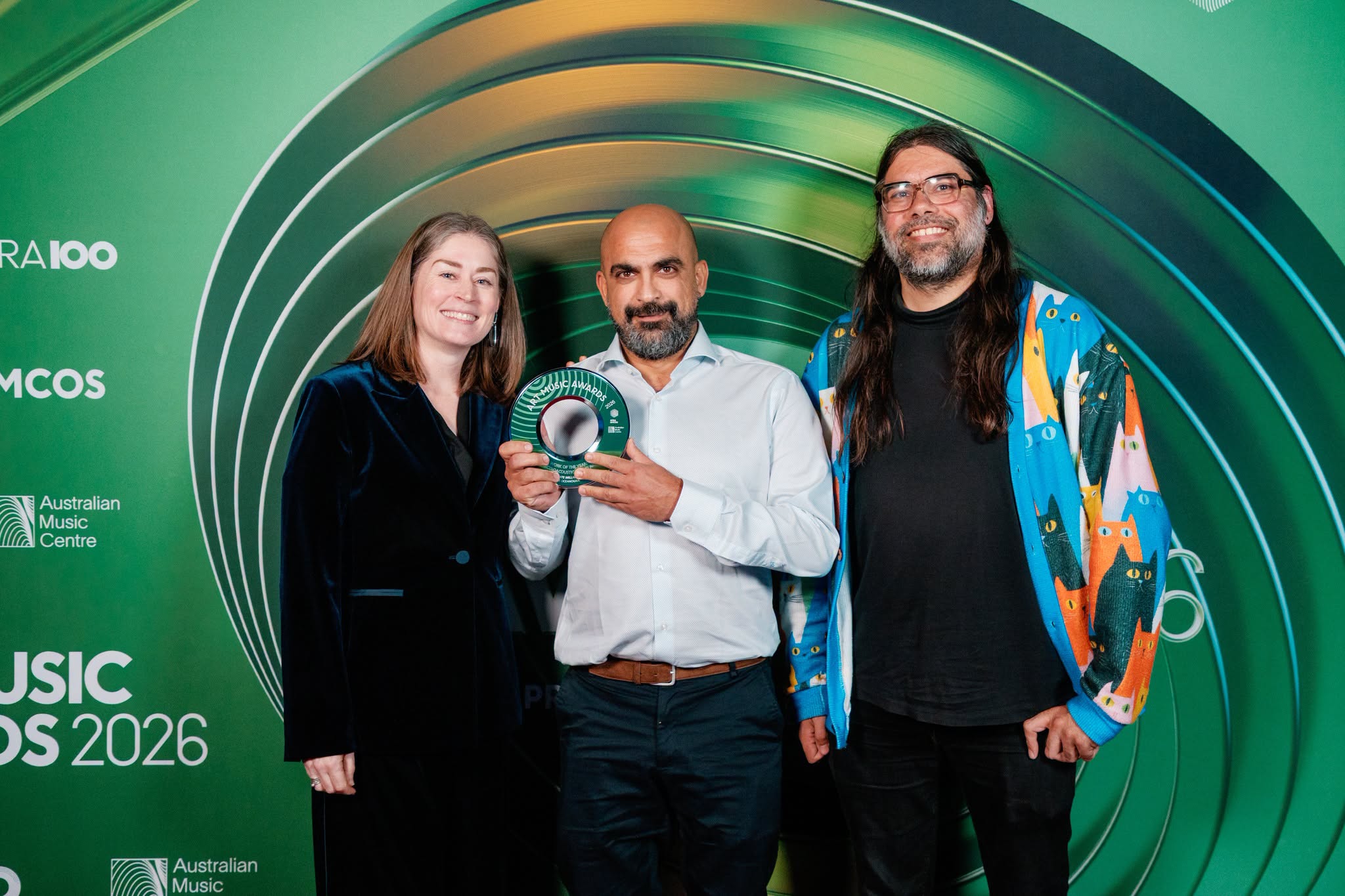
At the 2026 Art Music Awards in Melbourne
Public lectures
In 2024 I gave a public lecture, Oceans in Motion: How Oceans Affect Our Changing Climate, as part of the University of Melbourne’s July Lectures in Physics, a public lecture series that has been running since 1968. The talk is about how the ocean’s currents and turbulent eddies move heat, carbon, and salt around the globe, and how they shape and regulate the climate.
In August 2021, as part of the Atlas of Life South Coast National Science Week (13–21 August 2021), I gave a lecture titled The ocean currents in a changing climate in the symposium Our East Australian Ocean Hotspot: What is it and how will it change our coastal ecology. Both the slides and the recording are available.
The Conversation
I write for The Conversation when our research has a story worth telling to a wider audience:
- Antarctica has its own ‘shield’ against warm water – but this could now be under threat (May 2025, with Ellie Ong, Matthew England, and Ed Doddridge)
- How machine learning is helping us fine-tune climate models to reach unprecedented detail (August 2021)
- Satellites reveal ocean currents are getting stronger, with potentially significant implications for climate change (April 2021, with Josué Martínez-Moreno, Andy Hogg, Matthew England, Andrew Kiss, and Adele Morrison)
- Jupiter’s magnetic fields may stop its wind bands from going deep into the gas giant (August 2018)
Radio
In August 2018, Jeffrey Parker and I published a paper offering a potential explanation for Juno’s puzzling discovery about how deep Jupiter’s stripes extend. Our findings attracted lots of media attention, and in the weeks that followed I gave a few radio interviews discussing them.
In April 2021, our research on trends in ocean eddies came out, and there were several radio interview requests. I particularly enjoyed my chat with Ruth:
I often join the Breakfast show with Simon Lauder on ABC South East NSW to talk about the ocean. In April 2021 we chatted about our findings on ocean eddy trends:
A few weeks later, I followed up on a question a listener had sent to the show: why, on the New South Wales coast, can the water temperature drop dramatically even when warm winds blow from the north?
Another day we chatted a bit about tides:
In June 2021, I started my DECRA project on using machine learning to improve climate and ocean models, and wrote a piece for The Conversation on how machine learning can help climate science. The next time I was on Simon’s show, we talked about this:
Sometimes I go on the radio and talk about non-science-related things…